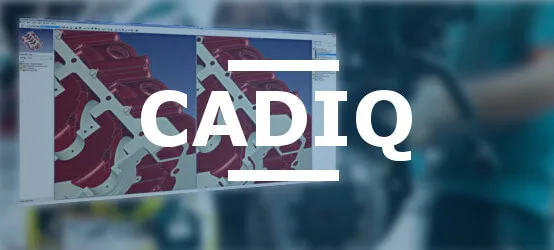
CAD Data Validation SolutionValidation Solution SummaryCADIQ validation solutions combine our leading expertise in interoperability improvement consulting with innovative validation technology. CAD Interop and ITI help customers put processes in place that help identify and manage the correction of problems stemming from design quality and product data interoperability issues. Resolution of these challenges is critical in order to improve downstream product data re-use. ITI TranscenData has been involved in developing software solutions and consulting methodologies based on real customer challenges for over 12 years and we are well positioned to understand the requirements of, and deliver solutions for each customer's unique needs. Redefining the Definition of "Bad CAD"For many years, CAD product data quality investigations were primarily focused on examination of piece parts or assemblies for defects within the context of that CAD system. Traditionally, the goal had focused on determining issues that would effect the ability to use this CAD geometry by other CAx applications. While this is still an important part of Product Data Quality, our customers have evolved in their definition of interoperability problems. With the expansion of ITI's technology and methodologies to including both CAD model quality and validation between digital product models, some examples of validation include:
Return on Investment for Model InterrogationReturn on investment from the implementation of a model interrogation process stems from reductions in labor costs which are attributed to unmanufacturable conditions within the 3D CAD model or assembly. These issues are not always found during the design process, and pose greater challenges to simulation and manufacturing groups. Typically, the issues require rework to the model or assembly. For example, if an product has 1,000,000 CAD models, and 10% of those models (100,000) require an additional twenty minutes of rework per model, the organization could conceivably waste 33,000+ hours in non-valueadded time. Multiply this by the U.S. Dept. of Labor's average wage for an engineer ($36.37) and the savings is $1M+. Most our customers have generally higher ROI percentages due to higher wage averages and unaccounted administrative costs. Not factored into an ROI calculation is the costs of delayed schedules andmissed market opportunities. Our Validation methodologies provides a prognostic/predictive element early in the design process, by allowing the user to interrogate the model for conditions that could cause problems for simulation or manufacturing groups. This "early warning" capability empowers the design group to proactively change the model and avoid the delays that are created by adding by more work to downstream processes. Return on Investment for Model/Assembly ComparisonWhen comparing and validating a set of 3D CAD models, ITI Validation methodologies using CADIQ are the electron microscope of CAD. These processes not only automate the inspection, comparison and validation functions, but it also identifies problem areas in the model that cannot be detected by the human eye. As with many companies moving to Model Based Definition approaches, the 3D master model becomes the sole authority. Any modification to the data, either through translation, conversion, healing/repair, re-mastering, or unintentional or undocumented changes, poses significant risks to the integrity of the data. This gamble extends to the manufacturing groups who rely on the accuracy of the model in their downstream applications. Exchanging data with the supply chain only increases these risk factors. The return on investment for model inspection, comparison and validation is measured through labor savings, quality assurances and adherence to regulatory statutes (some government agencies, such as the Department of Defense or the Federal Aviation Administration, require third-party validation of 3D CAD data). For example, an organization might dedicate a QA team to visually inspecting 3D models. A team of eight, costing an average of $90,000 per person, incurs a recurring annual cost of $1M+ with benefits and administrative overhead. In some cases, implementation of CADIQ based validation process can reduce these costs 60-90%. For addition information, see the tab "Validation Scenarios" that ITI TranscenData has developed through working with customers to address their business driven validation needs. CADIQ is ITI TranscenData's innovative 3D CAD model validation and product data quality product. CADIQ identifies potential shape and fit problems and compares differences between 3D CAD parts and assemblies. These quality issues and introduced changes often affect reusability of engineering data in downstream processes such as analysis, manufacturing and data migration. CADIQ's production tested validation functionality allows users to accurately compare geometry, topology, feature definitions and assembly product structure. Validation can be performed between up to four CAD models and leads to a deeper understanding of a company's CAD system revision, data exchange, legacy CAD data remastering, feature based translation or product configuration processes. If a company is creating products based on 3D CAD Parts or Assemblies and must avoid quality issues and unexpected change, CADIQ is an invaluable part of an effective design and manufacturing strategy. To learn more, please visit the CADIQ Product Page. MBDModel-Based Design (MBD) System ValidationModel Based Design (MBD) System Validation includes Model-Based Engineering, Model-Based Manufacturing and Model-Based Sustainability. With the objective of the model being the master, you can minimize the use of drawings, and integrate into all phases of the product lifecycle. A model-based Definition (MBD) Model includes:
Why MBD Model Validation?If “the model is the master” then downstream modifications must be reconciled with the product design model. If you “integrate all phases of the product lifecycle” then the design model must be reusable in simulation, manufacturing, support, etc. There is a need for MBD validation in the following scenarios:
Long Term ArchivalDocument any quality defects in the design model to set appropriate expectations for the reusability of the archive data. Verify that any derived forms of the design model, e.g. STEP, are equivalent in quality and shape to the master model. If using STEP, add validation properties to the STEP model which can be used by a future recipient to validate that a future translated (imported STEP) CAD model is equivalent to the master model. These validation properties could also be used to verify the equivalence of any archive data format conversions which are required to maintain the archive over time. Data Delivery CertificationCADIQ verifies that the design model has no quality defects which will impede anticipated downstream use of the model. It will also verify that any derived forms of the design model (IGES, STEP, CAD translations...) are equivalent in quality and shape to the master model. When using STEP, you can add validation properties to the STEP model which can be used by the recipient to validate that a translated (imported STEP) CAD model is equivalent to the master model. While CADIQ has always promoted Native System Interfaces as the most robust approach for validation, not all scenarios allow access to native CAD systems. This is especially the case with smaller suppliers that must adhere to typical OEM partner mandates or quality specifications. These procedures often specify that converted forms of original CAD Master Models be properly validated to confirm that the original product design intent was not altered. Validation ScenariosDesign for Manufacturing Reuse Verification Identify quality defects in the design model that impede reuse for manufacturing, e.g. tooling design. Identify the design features that cause each defect to help the designer effectively remove it. Identify shape changes between the design and manufacturing models to verify that they are acceptable within manufacturing requirements. Compare design revisions to identify shape changes to guide manual updating of the manufacturing model (rather than rebuilding it for each design revision). Design Revision Documentation Identify quality and shape changes between revisions of a design model. Verify that any previous quality defects have been resolved. Determine if any unintentional changes have been introduced. Legacy Design Migration Validation Identify quality and shape changes introduced while migrating a CAD model from a legacy system into your current design system. The migration method can be BREP translation, feature translation or manual remastering. When using neutral file exchange (IGES, STEP, Parasolid), identify if any changes are introduced during export or import. Compare migration methods to identify the best options. Translation Validation Identify quality and shape changes introduced while translating a CAD model from a supplier or partner's design system into your design system. The translation method can be BREP translation, feature translation or manual remastering. When using neutral file exchange (IGES, STEP, Parasolid), identify if any changes are introduced during export or import. After manually remastering a model, compare design revisions to identify shape changes to guide manual updating of the remastered model (to avoid divergence). Compare translation methods to identify the best options. Design for Simulation Validation Identify quality defects in the design model that impede reuse for simulation modeling. Identify the design features that cause each defect to help the designer effectively remove it. Identify shape changes between the design and simulation models to verify that they are acceptable within simulation objectives. Compare design revisions to identify shape changes to guide manual updating of the simulation model (rather than rebuilding it for each design revision). Engineering Change Validation Identify quality and shape changes introduced during modification of a design model for an engineering change request. Verify that the modified model has no quality defects which will impede anticipated downstream use of the model. Verify that all required changes were made as specified and that no unintentional changes were introduced. Use this to verify that the change documentation is complete and accurate. Complement the documentation with static and/or dynamic 3D graphics which highlight and quantify the changes. |
CAD Qualification and Validation - CAD Interoperability Solutions